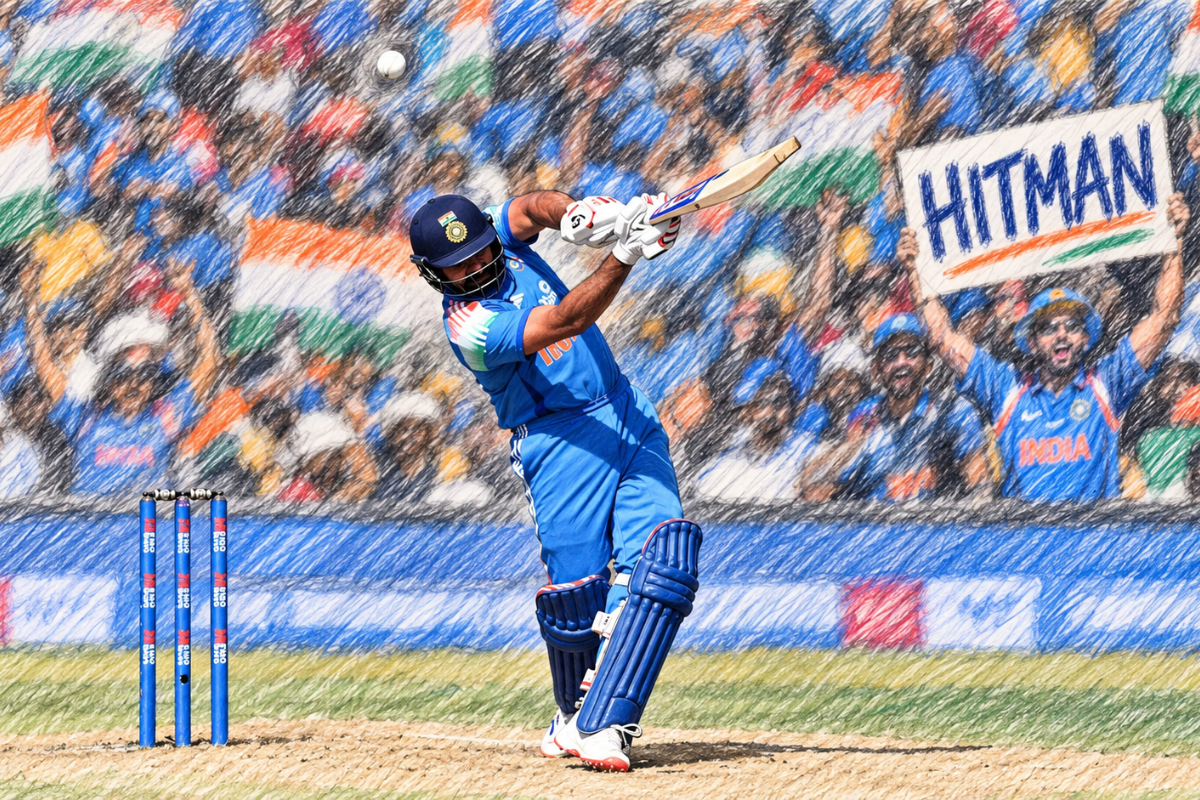


Rohit Sharma Is On A Leash, But There’s A Way To Break Free



For two years, Rohit Sharma’s first ten balls in ODI cricket were a declaration of intent: he scored at 123 runs per 100 balls, revolutionising ODI batting against the new ball. It hit a pinnacle in the 2023 World Cup where his intent and aggression at the start of the innings played a pivotal role in India’s run to the final.
Since the Champions Trophy in 2025, though, the strike rate in the first 10 balls has fallen to 77. He is lasting longer, 49 balls an innings against 35 before, and averaging more, 50.6 against 41.7, but his strike rate has dropped from 117.7 to 96.8. Nowhere is the shift clearer than against good length pace, the ball he once hit through the line and over deep midwicket. His strike rate on that length has fallen from 118.5 to 64, seven in ten balls are now dots, and six of his nine dismissals by seamers have come from it. India’s most destructive opener hasn’t lost his hitting. He’s just batting within himself, and not just at the start of the innings, even if that is where the change is really stark.
To be clear, this is not the story of a batter in decline. It is the story of a trade — early risk exchanged for time at the crease. His 27 ODI innings since January 2024 shows exactly where that trade has been made, and what Rohit could borrow from one of Australia’s best (no, that should read world’s best) pace hitter, Mitchell Marsh, without abandoning his new patience.
The trade off for Rohit Sharma
Split Rohit’s recent career before and after Champions Trophy 2025 and two different batters appear. The first, across 11 innings from January 2024, was the Rohit of the 2023 World Cup: fast, fearless and short-lived. The second, across 16 innings since, is something India have rarely seen recently from him in white-ball cricket.
| Jan 2024 to Oct 2025 | Since Oct 2025 | |
| Strike rate | 117.7 | 96.8 |
| Average | 41.7 | 50.6 |
| Balls per innings | 35.5 | 49.0 |
| Strike rate, first 10 balls | 123.2 | 76.6 |
Read one way, the drop in strike rate looks like a decline. Read properly, it is a choice. Add context, and the reason becomes even more clearer. Rohit was stripped of ODI captaincy post the 2025 Champions Trophy and since then, there’s been an evident change in his methods in the format. The context suggests that this is what this team management under Gautam Gambhir wants him to do — bat longer, lower risk early in the innings. It is in stark contrast to the Rohit of 2023 under Rahul Dravid.
He is facing 14 more balls an innings and scoring roughly six more runs each time he bats. The runs have not gone away. They have simply been pushed later into the innings. It’s clearly a trade-off, a purposeful switch in his methods.
Again, context is important. The whole retirement drama around Rohit during the England tour added to doubts about him lasting until the 2027 World Cup in South Africa. But with Ajit Agarkar moving away as chief selector and all indications now pointing towards a 40-year-old Rohit padding up with Shubman Gill at the top in the ODI World Cup next year, the question that needs to asked is if the switch in method is worth it? And if not, what can he do to make it worth it?
The length where it has all happened
Almost all of the slowdown sits on one length against pace bowling. Against good length balls from pace, the change is stark.
| Good length pace | Jan 2024 to Oct 2025 | Since Oct 2025 |
| Balls faced | 151 | 364 |
| Strike rate | 118.5 | 64.0 |
| Dot-ball % | 57 | 69 |
| Sixes | 9 | 2 |
| Share of pace dismissals | 2 of 5 | 6 of 9 |
His strike rate against pace as a whole has fallen from 126.8 to 94.2. Take the good length ball out and the rest of his game against seamers looks pretty much the same, probably even better. This is the length bowlers are feeding him, and the length that is now getting him out: six of his nine dismissals by pace since October 2025 (his first stretch of ODIs since the Champions Trophy) have come on it.
Two-thirds of the good length deliveries he faces arrive in the first ten overs, and there his strike rate on that length has collapsed from 126.5 to 59.4. The Rohit who once used the powerplay as his launchpad now treats it as something to bed in. This is not a completely alien Rohit. The Rohit who used to reel hundreds off for fun in the 2010s built his reputation in the format with low-risk starts that soared in intent and aggression as the innings progressed.
But now, India and Rohit might benefit from his 2023 World Cup methods than from the current version. The key detail is what hasn’t changed before and after the Champions Trophy. Pacers are not doing anything differently. Around 70% of the good length balls he faces are outside off stump, in both periods. The lines are the same. The lengths are the same. The change is coming from Rohit and it is hard to not categorise as purposeful.
The shots he stopped playing explain this further
Rohit from two years back had two ways of taking the good length ball on. Both have all but disappeared in the last one year.
The first was the slog across the line. Before October 2025, he swung at 8.6% of good length balls from pace, and they went almost entirely to one place: to the leg side, specifically, deep midwicket and long-on. Those 13 swings brought 44 runs and nine boundaries, including two remarkable sixes off Mark Wood over deep midwicket in the same innings against England in February 2025. Since then, the slog accounts for just 2.7% of those balls.
The second was the charge down the wicket. Between January 2024 and October 2025, he came down the pitch to 11 good length balls from pacers and took 30 runs off them, driving and slogging down the ground to long-off, long-on and deep midwicket. Since then he has advanced to ten such balls and scored one run, losing his wicket twice, but more tellingly, the purpose has changed. He now steps out mostly to push, defend or leave: to disturb the bowler’s length rather than punish it. Again, it seems like self-restraint more than anything else. What has replaced these shots is only adding to the pressure he feels.
| Good length pace | Jan 2024 to Oct 2025 | Since Oct 2025 |
| Defending or pushing | 21.2% | 34.6% |
| Leaving | 4.0% | 10.2% |
| Slogging | 8.6% | 2.7% |
Nearly half the good-length balls he now faces from seamers (45% to be exact), are blocked or left alone. Before October 2025, it was a quarter. His leaves have risen two and a half times. For a batter whose reputation soared by refusing to let the new ball settle, that is a remarkable change in habit, and potentially one that is harming him.
Where it really breaks down is what Rohit has replaced the intent on good length balls with. The drive and the flick. Between January 2024 and October 2025, the drive never cost him his wicket on this length. Since then, it has done so three times in 60 attempts. The manner of those dismissals matters. Rohit is not nicking off to the keeper or the cordon. Instead, he is mistiming the ball in the air to fielders in front of square.
Now, a couple of them have come when stepping out, but the intent has changed completely and instead of slogging to the leg, he’s looking to chip in front of square on the off side. When he does edge behind, it comes from defence. Nandre Burger had him caught by the keeper off a forward defensive in December 2025, and Hazlewood had him at second slip off a back-foot push in Perth two months earlier. This is an expected dismissal pattern for openers off that length against quality bowling. The change is again in his intent.
The flick tells a similar story. It used to be an attacking option for him in his attacking prime. He played it off anything from outside off stump to leg stump, sending good length balls to deep midwicket at a strike rate of 292. Since then, 62% of his flicks have come off balls on off or middle stump, and the strike rate has fallen to 167. Several have gone straight to short midwicket for no run. It has turned from a scoring shot into a nudge.
What still works for Rohit
It would be wrong to paint this as a batter who has lost his power. Drop a fraction short and the old Rohit is still there.
| Pace, since Oct 2025 | Balls | Strike rate | Sixes | Dismissals |
| Back of a length | 104 | 133.7 | 12 | 2 |
| Short | 19 | 310.5 | 4 | 0 |
| Full (incl. yorkers and full tosses) | 46 | 154.3 | 2 | 1 |
On back-of-a-length balls from seamers, he has hit 12 sixes in 104 balls since October 2025, against three in 59 before. On the genuinely short ball, he strikes at 310 and has never been dismissed across the whole period. Nobody in the world in this time period punishes short balls at the rate Rohit does, not even Mitchell Marsh, who’s the world’s best horizontal bat player against pace.
Meanwhile, his cuts and steers against good length pace have also become more productive, from 90 runs per 100 balls to 122. This is the other half of the trade, and it explains the method. He is not trying to hit the good length ball any more. He is waiting for the one that isn’t, and punishing it when it comes. The cost is the dot balls in between, and the pressure they build, which is eventually leading to escape shots he isn’t fully convinced he should be playing.
But if Rohit and the team management are keen on him playing himself into the innings, Marsh is a good model for Rohit to look upto in order to maintain his aggression with reduced risk.
The Mitchell Marsh model is something Rohit can take a leaf out of
Mitchell Marsh is, by most measures, the most destructive opener against pace in ODI cricket right now. Since January 2024, no batter with 300 balls against seamers hits sixes off them more often: one every 17.5 balls. It is tempting to hold him up as the answer to Rohit’s problem. The data says it is a little more subtle than that.
On good length pace, Marsh is not a lot more productive than Rohit. He strikes at 65.4 on that length; Rohit, since October 2025, at 64.0. Both score off only about three balls in ten. What Marsh does better is survive while scoring, and the difference lies in where and how he plays.
| Good length pace | Rohit (since Oct 2025) | Marsh (2024 to 2026) |
| Strike rate | 64.0 | 65.4 |
| Balls per dismissal | 61 | 85 |
| Share of runs straight down the ground | 7% | 29% |
| Comes down the pitch | 2.7% of balls | 10.6% of balls |
| Strike rate when stepping out | 10 | 96 |
| Drive strike rate | 132 | 151 |
| Leaves | 10.2% | 14.6% |
Three things stand out. First, Marsh plays straight, really straight. Nearly a third of his good length runs go back past the bowler, to long-off and long-on. Rohit’s drives go square, through point and backward point, the region where his catches to cover and deep cover come from. Of course, Marsh has a height advantage and it helps him go down the ground easier. But the principle does not depend on reach. Rohit can drive straighter along the ground rather than over it. By looking to access in front of the square with drives off good length pace, the risk element is high.
Secondly, Marsh moves his feet to attack. He advances to one good length ball in ten, and drives at 192 runs per 100 balls when he does. In fact, stepping out to pace is a significant addition to Marsh’s repertoire and it can be seen in his batting in the recent IPL and Hundred seasons too. Third, he leaves more, letting the ball he doesn’t want go rather than nudging it to short midwicket. Basically, Marsh waits for the bowler to err, and punishes it brutally. Rohit does it too, but loses patience quicker than Marsh.
None of this asks Rohit to go back to the slog over deep midwicket. It asks for a middle ground between the batter who took Mark Wood apart and the one who now blocks seven balls in ten. It asks for him to play straighter, step out with intent or take singles. Each of those keeps his new patience intact while taking away the pressure that is currently getting him out.
The 2027 World Cup will be played in South Africa, Zimbabwe and Namibia, where the new ball does more (even if drop-in pitches come in) and seamers who hit a good length are the main threat. But they also offer tons of reward for patience if he does play himself in. His new method has made him slightly harder to dismiss. Whether he can find a way to score from it again, without giving up what he has gained, may decide what kind of opener India take to South Africa.
Raw data source: Darpan Jain
For more updates, follow CricXtasy on Facebook, Instagram, Twitter, and YouTube.