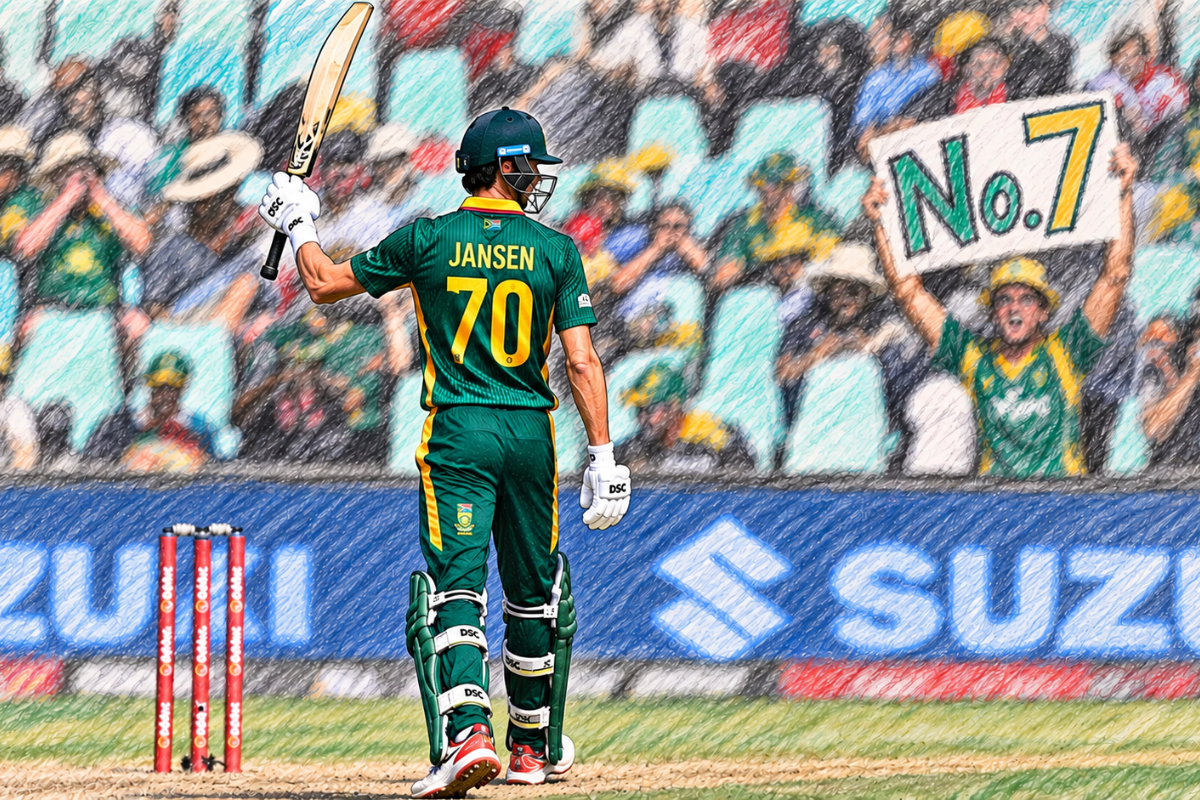


Marco Jansen Emphatically Solving South Africa’s Longest-Standing ODI Problem



Marco Jansen is 9 off 9 in a game against MI Cape Town in the inaugural SA20 season. Sunrisers Eastern Cape need 64 off the last five overs against the best attack in the SA20 – Kagiso Rabada and Jofra Archer with the new ball, Sam Curran for first change, Rashid Khan and George Linde as the spinners. Rashid Khan has the ball here. Six balls later, four have gone for six, and another for four. Nobody in Cape Town that night knew it, but South Africa’s longest-running selection headache had just been solved.
To understand why that over mattered, you need to go back to 2015. South Africa are forced to pick between batting and bowling depth at the 2015 World Cup, choose to go with the former, and find themselves handing AB de Villiers and Farhaan Behardien major bowling duties. The lesson is clear: without a genuine No.7, South Africa will keep facing the same impossible choice. But the solution just isn’t there in front of them.
Four years later, Andile Phehlukwayo has a great year (by his standards) with the bat in the lead-up to the World Cup. Chris Morris, Dwaine Pretorius, Wiaan Mulder and Phehlukwayo are in the running for all-rounder spots in the 2019 World Cup squad. The No.7 spot falls to Phehlukwayo for whatever reason. He finishes the year with a batting average of 42 from No.7. South Africa’s No.7 position, where Phehlukwayo bats 14 out of 19 times that year, averages 35.5 in the year.
South Africa and their No.7s
At the time, it is the second-best that position has averaged in a year in ODIs for the Proteas. But the fall is steep. From 2020 to January 28, 2023 (I will come to the significance of the date), there is a steep fall from the lofty numbers in 2019. South Africa’s No.7s average 12.81 in this period, the second-worst for any side to play ODIs during that time frame.
And it’s not just the average that suffers. The strike rate is a shocking 64, second-worst again, when No.7s of sides like New Zealand, Australia and India go at a rate close to or above 100. 19 of the 29 innings from No.7 in this time frame have again come from Phehlukwayo. It’s not that South Africa do not know that their No.7 position badly needs to do a better job. They just don’t have an answer. They even bring Wayne Parnell up the order in a few games, without much success.
The arrival of Marco Jansen
Then Marco Jansen happens on January 18, 2023, six days before the SA20 pauses for nearly 10 days so that South Africa can complete their commitment of an ODI series against England. Jansen finishes with 66 off 27 balls that night as Sunrisers romp home to a victory with three balls to spare.
Just over 10 days later, Jansen pads up to bat at No.7 for the first time in his ODI career in the second ODI against England in Bloemfontein. It’s hard not to conclude that that one night in the SA20 played a hand in the promotion. Since then, he’s batted 25 times in ODIs and 24 of them have come from the No.7 position. His bowling potential was always acknowledged; the batting was almost a bonus.
It’s crazy how long South Africa went without even the semblance of an all-rounder. Since 2015, only two South Africa players have done the double of 500 runs and 25 wickets in ODIs. Until recently, Phehlukwayo was the only one, and he wasn’t particularly good in either discipline. Since Jansen’s induction, though, South Africa haven’t had a single concern about the all-rounder spot in the format. South Africa No.7s have averaged over 27 with a strike rate of 106.3 since Jansen started occupying the spot. Few teams have had more impactful performances from their No.7s with the bat in this format in this period.
Jansen has already had multiple high-impact batting performances – the 2023 World Cup knock against England and the incredible takedown of India’s attack in a run chase that went from improbable to ‘how did they lose it’ at Ranchi last year sit at the top of the list, but it doesn’t stop there. The 75 off 59 balls against the Aussies at Kingsmead came when the team was in a precarious position after the dismissal of David Miller. This is aside from quite a few extraordinary knocks in T20Is.
Is Marco Jansen one of the best ODI finishers today?
In fact, it would be disrespectful to shove Jansen into the No.7 bucket alone. There’s a very real argument to be made for Jansen being one of the best finishers in the ODI format itself at present. Since 2023, among batters to make over 500 runs in the format, only four have a better strike rate than Jansen’s 115.9 – Glenn Maxwell, Heinrich Klaasen, Travis Head and Sean Williams.
From the middle-order to lower middle-order bracket, Jansen is in an elite club with Klaasen and Maxwell, unarguably two of the finest ODI middle-order match-winners of the modern era. But they have both retired. It is early days still but Jansen has a strong claim to the mantle of the best finisher in ODI cricket today.
What makes him particularly impactful is his reach, courtesy of his six-foot-eight stature. His ability to dispatch good length deliveries makes him a menace to bowl at for fast bowlers. Since 2024 in ODIs, Jansen strikes at a rate of 135 vs good length balls from fast bowlers, the third-best for anyone to face 30+ balls in the database in this period (Klaasen and Jake Fraser-McGurk above him in the list).
ALSO READ: Who Are Australia’s Next ODI Batting Guns for World Cup 2027 and Beyond?
Marco Jansen’s long levers
If you err on the fuller side, Jansen is even more brutal. He goes at a rate of 156. The sample size for Jansen in ODIs isn’t huge, but the pattern holds in the SA20. When fast bowlers bowl in the 2-5m length band (full length to fuller side of good length balls), Jansen strikes at a rate of 234.6 in the SA20 across all seasons, the best for any batter to face at least 25 balls. There are few better at using those long levers than Jansen in modern white-ball cricket. With his reach, he is also harsh on spinners who bowl the traditional good length.
Short balls at pace and change of pace could still work against Jansen (there isn’t a big enough sample size to validate this), but the margin for error against him isn’t as big as it should be for bowlers against a No.7 batter. And South Africa haven’t just found a No.7; they’ve found one who gives them ten overs. With Corbin Bosch and Gerald Coetzee also in the mix, it is safe to say that the all-rounder curse that haunted them in multiple world tournaments in the recent past has certainly been lifted.
With a home World Cup coming next year, Jansen’s revolutionary returns with the bat hint that South Africa might just have landed upon someone who could finally fill in the long vacant shoes of Lance Klusener.
(data source: Darpan Jain)